Monday, September 04, 2006

Teachers' Day Mass Lecture

(i) Speech by Minister

http://www.moe.gov.sg/speeches/2006/sp20060904.htm

The Minister's speech has brought in some good news... the GROW package that everybody in the service has a bite share...


Some reflections:

  • Growth: Sabbatical Leave for Education officer - yes, now we can go for some 'enhancement programmes' without having to face 'monetary shortchange'. I think that's a welcome move... hm... something can be considered and tapped on in the near future :D TIll now, still have yet figure out if I've already tapped on the PDL while in the OutReach Programme... hm... one day will find out, if I were to tap on this scheme :D
  • Recognition: Extension of the promotion grade... this probably sends a message that to many who has already reached the 'terminal' grade. I think this is introduce to address the handful who are 'unmotivated' or 'disillusioned' who have reached the 'maximum'... there are always a couple of such cases raised during the annual staff ranking sessions. Will this bring in some new light that they can look forward to? On the other hand, that reminds me when the GEO1A1 and GEO1A2 grades were introduced many years back... many of us who were then GEO1A were automatically be promoted to GEO1A2... so, will this happen again? If yes, it will not leave much impact on the existing GEO1A2 officers, isn't it? Oops, on the other hand, does that mean that HODs who are currently GEO1A2 will have to cross one more grade before moving on to SEO1?
  • Opportunities: Did not quite catch this part of the presentation, probably tied to Recognition?
  • Well Being: More admin staff... yes, a welcome move, definitely... though there are some many newly created posts... do we have the right people to fill up the vacancies? It's just like when MOE decides to step-up its recruitment of teachers... in the school end, the quality of the teaching force (in particular the more recent batches) has changed... we have good gems amongst them, however, there are also more challenging ones that the school has to take in and manage... we don't manage just the 'changes' in the pupils' profile, but also that of the teachers! Oh yes, not forgetting the $400 fund that education officers can tap on for other forms of 'enrichments' including subscription to professionally-related magazines... hey, that reminds us of the "Computer-copayment" scheme that was introduced in mp1... hm... we can save that to get new gadgets???


(ii) Understanding Digital Kids - Teaching & Learning in a New Digital Landscape (by Ian Jukes)

Key Inputs from the lecture

  • Changes in an environment that faces digital bombardment
  • Digital Immigrants vs Digital Natives
  • Digital Natives use Digital as First Language while Digital Immigrants (like many of us) speak Digital as Second Language. This somehow creates a "Digital Divide" in terms of "Communication". Hence, it is important for us, especially educators to recognise the fact that pupils of today are different from pupils of the yester-years (ie. whom we were!). It is therefore also necessary for us to understand who are pupils are... in terms of the changing learing habits... so as to 'prescribe' the appropriate approach and 'employ' the right strategies.
  • Digital Learners prefer (i) Parallel processing and Multi-tasking (ii) processing pictures, sounds and video (ie. multimedia) (iii) random access to hyperlinked multimedia information (hence, the conventional sequential approach may not work well here) (iv) network simultaneously with many others (v) learn just-in-time (that opposes to what many teachers do - Teacher for "just-in-case") (vi) instant gratification and immediate rewards (vii) learning that's relevant, instantly useful and fun.

Other useful information

Some reflections:

  • Throughout the lecture, I was wondering... what's the speaker is trying to drive at... on one hand, he reminded us of the change that's happening... and we are to be mindful and sensitive who are 'clients' are (ie. the students) - in the chinese saying, 知己知彼,百战百胜。Only with this we are able to identify the most appropriate strategy to bring about the desired outcome. That's part of the 'life-long' learning process that all teachers will have to undergo... pupils of today is different from pupils of the yester-years. Indeed, this applies not just to pupils, but also our teachers, too... our teaching force is also having an increasing number of 'digital natives' too.... the younger lot of teachers... that reminds me what Mr Chua always tells the SCC... our teachers are different, the profile has changed... so are their values, their perspectives of things and how they do it... as the middle management, we sometimes simply could not understand why some teachers do not conform to the 'norm'... forgetting that... they are different... or should I say, we are different... and therefore they have difficulty in understanding where we are coming from and why things are to be done differently... indeed, I wonder, who carries the 'baggage'?
  • On the other hand, to hear this lecture, perhaps it's the way it's being delivered (???) Suddenly, I just felt... hey, are you pointing out to us what we lack of? Think deeper... hm... our competency level has ....??? Hey, a bit discouraging when it's supposed to be something inspiring and spirit-lifting kind-of-a talk!

Other observations...Several things struck me while waiting for the event to start...

  • As teachers, we are expected to be role model... we walk the talk, right?
  • Is exhibiting the basic social etiquette something expected of us? Let me lower this by one level... do all teachers know what's are some basic social etiquette? (To be fair) We are ignorant of what's expected if we don't even know or have it, right?
  • Punctuality: The event starts at 2.30 pm... teachers were still scrolling in... walking while talking on the handphone... While the ushers tried to direct them, many of them ignored... We expect our pupils to observe punctuality... so, do we walk the talk?
  • Being Considerate: This year, to save manpower, the organiser placed the goodie-bags on the seats... those who swapped the seat took the bags away... do they expect 'auto-refill' to happen here? OK, are they sending a message, "Latecomers? So, you deserve to go without the bag".
  • Politeness: Leaving the event half-way, rushing out immediately after the show... does leaving the seat slightly earlier, leaving the hall earlier helps a lot in reaching home earlier? I wonder...
  • These are ... TEACHERS!!!???
  • On the other hand, perhaps I belong to the 'older' or 'more conservative' generation, some of the presentation slides (that were suppose to be the time-filler) before the actual event was 'distasteful', perhaps a stronger word 'disgusting'! No doubt the organiser may want to portray a light-hearted atmosphere to the event, many of the images are not appropriate - perhaps reserve that for an aesthetic event?
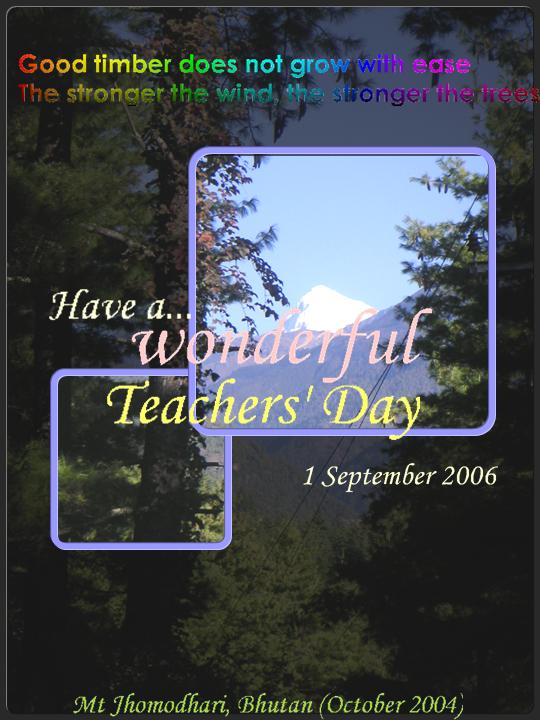
Friday, September 01, 2006

Teachers' Day


Last night, I had the privilege to attend the Teachers' Day Rally @ Singapore Expo - words direct from the mouth of our Prime Minister.

... some thoughts...some reflections...

The many peaks of Excellence - that is already happening in schools, but a handful at this moment... yes... it's moving up to 30% in the near future. Yes, perhaps there's how our education system celebrates diversity. Saying is certainly much easier than putting it in action. On the other hand, it's like the Chinese saying, 百花齐放. It has slowly changed the mental model of what defines a 'good' school... it's no longer just being academically strong... though it is still one that draws the most attention - in this place where paper qualification is still the key, out of the entire education system, though in the recent years, other affective factors such as character development comes in. Now, it seems like everyone has a place, be it in the fields of character development, sports, arts, etc... yes, the first step was when the ministry introduces the School Excellence Award... it's not just academic excellence, but holistic development of children under our charge... as such, such recognitions/awards are just

Leveling up - every child will be taken care of... somehow, this is the perceived message... no one will be deprived from schooling because of financial disadvantage. Yes... I think that's the beauty of our system... Remember several years ago, there's this work on 10-year Compulsory Education...

Perhaps it's the environment that I came from shaped this mental model. I was lucky to be in a school that has strong financial support from the school management committee (SMC)... "Money is not a problem" - that's what the principal always said... and that certainly freed us up in planning and implementing our programmes, as long as it is purposeful, meaningful,... and yes, pupils who are in the financial scheme are taken care of, not only through the various provisions by the ministry, but also those by the SMC. Yes, children should not be deprived from any opportunities because of being financially disadvantaged.

Socio-Emotional Bonding... to Singapore - National Education... our pupils' sense of belonging to the country... this is an reiteration of one of the key messages in the National Day Rally. Coincidentally, this was briefly touched on when we had lunch... when we talked about the amount of effort that was put in to bring out the nationalism amongst the younger generation. All agree that the school has done alot in this aspect, in raising the awareness of national identity, and the importance of feel and love Singapore. Some find that we have done so much that this over-dose, to some extent, made it too 'artificial', to 'force it down the throat'... it's probably something should not be taught, but a natural grow - the love, the belonging - from the individual. What's happening at home has an impact too! The influence from parents, in particular, shapes the kids' mental model, too!

Well, perhaps one can tell how successful it has been only when this 'natural bonding' to the country is being tested, in some stage. Back at home, the older generation has somehow stronger emotional bond to where our ancestors come from, although they are born and locally breed. Why? Simply, the sense of belonging? or they see the land beyond reach a better one? (There's always this chinese saying, the foreign moon is always brighter.) Well, I guess I found myself more Singaporean than ever, after going through the emotional challenge when I was away... that one year has brought me closer to the land I belong... on the other hand, it's also dangerous, come a second thought... I appreciate my country more, many a times, based on comparison... yes, Singapore is a better place to live in, the system we have... though sometimes seem 'too rigid' but it's for the good of the country... but not to forget, I'm comparing what we have to a developing country. What if I've been immersed in one that offers more than what Singapore does? What will my thoughts be? I guess that will be the real testing - to test my sense of belonging - what guides my thoughts and actions! I can't tell... perhaps should look out for such an opportunity to test it out!

Teachers - the assurance of support... and more teachers... yes, if we look at the recent changes in the system... into the professional wing... more funds have been channelled for schools to employ teaching aid, to purchase support, etc... On the other hand, sometimes, despite the fact that there is money, it's not easy to get the right candidate to fill the post...

PS: "Teach Less Learn More", "Prescribe Less, More Work"

Thursday, August 31, 2006

Learning Journey @ Comex

Task
What (marketing technique, gadget etc) did I notice at the exhibition that could be applied in (i) my work in ETD, (ii) teaching and learning?

~~~~~~~~~~~~~~~~~~~~~~~~~~~~~~~~~~<@

(i) Something 'caught' my eyes...
A gadget: The Multifunctional Camera System (5-in-1) ~ Casio YC-400 (cost at Comex was $2,288)

  • This gadget comes with a digital camera and a stand.
  • It has been in the market for 2 years.
  • Indeed, the 5-in-1 gadget can act as a visualiser, scanner, digital camera, voice recorder and whiteboard capture function.
  • The digital camera - detachable piece that takes picture (when used as 'just' a digital camera), records voice, and captures 'live' what's on the whiteboard, which can be captured in the PC/notebook computer the gadget is attached to... and of course, this already explains a 'sub-feature', ie. as a visualiser.
  • However, to link up to the computer, the camera has to be connected to a stand with a connector. This connector is specially customised for this model of digital camera. As a result, the gadget does not offer that much flexibility as we would expect it to be.

What do I learn from this...

  • For any design/plan: It is good to be comprehensive - it's just like when I was amazed by the many features that gadget comes with... the all-in-one concept... however, we need to offer flexibility, too... too rigid a structure may backfire, or overshadow the benefits the original intent (it's just like the gadget that works with only ONE type (one brand and one model only) of camera). This also explains why it has yet been popular in the market.

~~~~~~~~~~~~~~~~~~~~~~~~~~~~~~~~~~<@

(ii)... in Teaching and Learning...

Ironically, I was more attracted to the exhibition organised by the "Singapore Photographic Society" as compared to the many many gadgets around in Comex. However, there's certainly a reason why such an exhibition in an IT-related event... What's the thing that constantly we come across as we walked pass the booths? Digital Cameras!!! A very very wide range... saw an interesting one - ie. by Olympus - one that survives in water!!! OK, without any 'coat' to protect it! Digital cameras have become so cheap! With a couple of hundreds we can get one! Of course, there are very sophisticated and costly ones, too... OK, that's beside the point.

Indeed, it has become so affordable that schools can afford enough of such equipment for teaching and learning nowadays. Have been trying to promote the use of blogs in Maths learning... and images and blog can marry to work out interesting areas for pupils to explore indeed... This brings to one activity we did earlier this year - IBL in Maths teaching and learning - the activity provides pupils with opportunities to learn Maths beyond the classroom (at different phases of learning):

  • As a trigger, pupils can go round in groups to capture pictures of objects - as far as they present 4-sided figures. Pupils can post them in the blogs and ask questions or comment on the 'findings' of each other.
  • Alternatively, after exploring and having learnt the properties of specific 4-sided figures such as parallelogram and trapeziums, pupils capture pictures that illustrates these shapes and discuss how to check the properties of these shapes they took with the properties them listed out earlier. This activity not only consolidates the learning, it also helps to surface any misconception that needs to be addressed to, in a timely manner.

Saturday, August 12, 2006

UK Study Trip


Some reflections...

It happened more than a month ago... To be exact, I was home exactly one month...

The trigger of the trip is "Standards"... See what has happened out there, glean learning points from others so that we can "learn from others' experiences", I guess this is one way to do things more efficiently (by not reinventing the wheels, spending time to 're-construct' the 'test' and spend time to 're-test' to test the outcomes?). Oh yes, it comes with a 'cost' - as a package.

Of course, there are lots of new discoveries gathered through this trip... it has certainly broaden my horizon... what I know about education systems... yes, the contrasts, empowerment (and the price tag that goes with it), etc... an eye-opener (at least, to me...)... that we don't see in Singapore, perhaps, it's not "we" but "I" have not seen or noticed here... yes, must admit that I have not gotten enough exposure to what we have back at home... (oh yes, it's the same when I was at Bhutan, too... hm... I've not learnt my lesson? or it's an on-going lesson that there's always too much out there to learn about, so what determines is having the 'right opportunity' and the 'timing'?)

The "UK trip Report" thingy has been hanging back in the mind even before we set off on 2 July! Yes... all study trips come with a report... so, what's new? But, I guess, it's when I compared with those we did in when in school, and the implications, etc...


It's the preparation that came before the trip was materialised, and getting ready to go out to seek 'answers'(?), information - not just any, but useful ones!!! It's not just the two who went have to prepare... the amount of inputs that Sai Choo and Hwee Peng gave (yes, the to-do list, apart from the set of questions that Shoo Soon drafted for the UK partners) , what to look out for... and sitting down to discuss the focus and what-to-find-out for the trip... OK, all these preparation had successfully 'heightened' the level of anxiety and my level of 'alertness' when out there scanning... on the other hand, also learnt that an over-dose of information is no good too... we have to filter it... as the report eventually has to be focused back to its original intent.

I guess, it's the Singaporean style, trying to "squeeze" out as much as we want from our counterparts... to some extend, I guess Keith must have started to wonder... how minute the details we were trying to find out... The preparation of the report was tough... ok, for one who does not write much, whose 'analytical' skills is still at novice stage (?) hahaha... of course, I thought, writing the Annexes will be a much manageable task to me... Certainly, I marvel the way Sai Choo tightened up the report and re-geared the way it should go... She has asked several times, "Do you agree?", checking on whether the suggested way is better than it was previously put across. Yes! It has certainly helped to pull the 'split souls' together, and has given the entire report a body with the parts at its right places - Thanks for great help! On yes, large part of the credit goes to Shoo Soon, too... who's able to put all the inputs and thoughts together... despite of the working in the wee hours of the days/nights! hahaha...

Looking back, the entire "after-trip" report preparation process has help to consolidate and enriched the entire outcome of this trip. Now, I come to realise that the learning really takes place "after", when trying to piece the information together to analyse them, make sense out of them. Of course, all these also fall back to the comprehensive background information and data collected. Both are equally important.
~~~~~~~~~~~~~~~~~~~~~
Some learning points... (based on some of the findings)


  • Resources: One common strategy that the various educational organisations adopted to provide support to schools is on resource development. Be it Becta, DfES, QCA or even the LEA at Birgimham... Indeed, to a large extent, I think they go for the abundance mentality... it's good to have the things there, "when you need it, you can find it"... comparing with the approach we undertake here... do we see some similiarity?
  • I believe we all share the same, fundamental intent, ie. to provide something to others to start off with, this is the most basic form of support that any implementation (of new idea, initiative) should come with...
  • On the other hand, riding on this, we also came to realise that these resources might not have serve its intent - not that they are no good or not enough, but it's the mental model, the habit or practice that most teachers have - they prefer to create their own resources, seek professional aid from nearby sources such as their peers or the likes in other schools. Why? why? why?
  • We don't really have a sense of the pattern in Singapore yet, as the stuff have not been formally rolled out yet. However, looking at the response to implementing the lesson resources in the pilot schools, can we pick up some signals, too?
  • Personally, as a teacher, I would like to tap on resources, however, don't have the time to check around... and often, creating it will probably be much faster and I can straightaway customised for the class!
  • Learning from the UK counterparts, and some of the happenings we encounter with the pilot schools now, perhaps, there's a need to look into the amount of effort to put into the resources - not in terms of just quantity (which seemingly the subject teams all currently are facing the pressure), and I think, more importantly, how to "sell" these resources, anchor it such that they are not just resources, but... to fit into a bigger picture to drive the implementation of the baseline standards of pupils - perhaps from the teachers' perspective as well, and not forgetting the middle management, especially, since the teachers take cues largely from the heads.
  • Perhaps the recent strategy of pushing it through the curriculum map is a good one, to leverage on existing structures. It also provides a more wholesome picture that all it's all about teaching and learning...
  • I guess, this is still single-loop learning

  • Curriculum integration, we see a rather different approach that our UK counterpart undertakes. I guess, that's an example of seamless integration of technology into teaching and learning... ICT is built into the national curriculum. Though specific skill sets are not spelt out, the 'type' of skills are outlined within the curriculum delivery.
  • It suggests points at which ICT can be used in mathematics. Eg. Generate functions from plots of data, for example, from science experiement, using simple curve fitting techniques on graphing calculators, or graphics software to explore the transformation of graphs (National curriculum 1999). It lists the main uses of ICT in mathematics in keystage 3.
  • Probably, based on observation in the classes visited, it seems like teachers see the teaching of skills is kind-of-a "by the way"...
  • From my experience and observation (while in school) - for the first IT Masterplan, and mp2, driving IT by a 'second' party is a challenging task. It guess, it boils down to ownership. Who owns the IT component in the subject integration process.
  • From the HOD/IT's perspective, we are here to support the instructional programmes, to bring in the technology aspect, to enhance the teaching and learning, to bring the quality of learning to greater heights, to enrich the learning experience of the pupils by opening up more avenues to learn.
  • However, from the HODs/IP perspective, very often - coverage of syllabus comes first! (I though it was only common in secondary schools... however, after working with a couple of primary schools, I realise that this mentality is common regardless of primary or secondary schools HODs/IP! Of course, to be fair, we also come across those who manage this ICT 'intrusion' differently and positively!)
  • Drawing points from the UK model, perhaps re-visiting the approach we undertake will shade some light on how this baseline can be perceived as part and parcel of teaching and learning. Probably, it is best for the teams (baseline & curriculum) to come together to see how we can leverage on each other role(?) and synergise - to see, package and sell all as one teaching-and-learning package.
  • This is probably a double loop.

  • ICT implementation in curriculum - what's observed in the Robin Hood Primary strikes most is the integrated approach. It sounds more like project work - where inter-disciplinary approach is adopted. It allows the subjects to come together in a thematic way, it blurs the line... the subjects are no longer so compartmentalised. Isn't this one way to link to bring about authencity in learning? And it is obvious that technology has a role to play, to support such approach.
  • Well, I think we also have to recognise the fact that as we move up to secondary levels, it calls for certain level of subject content specialisation. Hence, though we work togwards providing opportunities to allow fabrication (eg. IPW lessons in schools, co-curricular programmes), subjects are still very much on their own - to maintain the rigor of what needs to know. I guess it's something non-negotiable... and definitely, it's beyond us...

Saturday, June 17, 2006

Workshop: Collaboration & Security in MS Applications

on 16 June 2006 @ Ahmad Ibrahim Secondary School

What's covered in the workshop (some notes)
1. Sharing Comments/Merging Documents in Word

Using the comment feature, there are 2 ways to collect inputs from various people

  • a document can be circulated to various people in a sequential manner, and each will each their comments to the same document. By default, the 'reviewer' will be reflected (based on the user name they log on to)
  • the same document can be duplicated and send to all reviewers simultaneously. After which, use the merge feature to merge the comments. The disadvantages are: The reviewers have no idea what others have commented; when there is a repeated action, the input of the earlier merged document maybe overwritten by the latest copy that merges with the document.
2. Tracking Revisions in Word
  • revisions can be displayed in 2 different ways - via the normal view and the print view.
  • it enables one to keep track of changes made to a document.
  • feature that's new and useful (to me): Saving the work under different versions - though saved in the same document, different versions can be saved such that it reduces trouble in the way we used to work on documents (when we save with different filenames). Now, all can be saved under the same filename.
3. Managing Files Security in word
  • setting passwords at different stages - to open the document, to make changes to the document.
  • it's a disappointment that digital signature cannot be demonstrated in the workshop.
4. Working with Comments in Excel
  • feature that is new (to me): Comments in different Excel worksheets/workbooks can be merged
5. Sharing Workbooks in Excel
  • feature that is useful (to me): Normally, the workbook is placed in the server so that it is accessible to many at one time; however, once it's opened, subsequent users can only view the spreadsheet as a read-only file. Now it can be 'shared out' such that multiple users can input data into the same spreadsheet - however, take note of the 'winner' overwriting the previous entry.
6. Using Worksheet Protection in Excel
  • Protecting the worksheet as a whole or releasing some cells such that users can make changes to selected cells.
  • feature that is new and useful (to me): Protecting different sets of cells such that these are accessible by selected groups of people.
7. Collaborating on a Presentation in PowerPoint
  • A new feature that I came to know, however, it's only possible if using Outlook as the emailing application. On the other hand, have yet find a place where this feature comes in useful or helpful to what we're doing now.
8. Security and Packaging in PowerPoint
  • the feature is similar to 'Pack-and-go' or the saving the file as an executeable file.
  • feature that is new and useful (to me): saving the fonts embedded into the presentation. This is certainly very very helpful and releases the constraint to confine to the common fonts.

This workshop is definitely helpful to those of us who conduct workshops, and when designing baseline lessons.

Monday, May 29, 2006

Learning Journey to GIC

It was a loud, cheery and smiling voice that greeted me when I stepped into the reception area of the 37th floor... Oops! Is this Singapore? For a moment... hm... there leaves the very very first impression... :D

The Government of Singapore Investment Corporation Pte Ltd. Its name is so confusing... is it owned by the Government? or it's a Private Company? There it came clear at the end of the trip - it's initiated by the Government of Singapore, and it's engaged by the government to manage the country's reserves! It has a strong board include big names like MM Lee, PM Lee, and some cabinet ministers. And... it has one and only one client, that is, the Singapore government!


Some pointers from the various presenters
Qualities:
Analytical & Quantitative Skills
People Skills
Sound Judgement &
Decision making - making decision based on INcomplete set of info; to be
comfortable with uncertainty
Initiative
Responsibility &
Accountability
Integrity - stick to the decision, even if it goes wrong
Communication skills - Precision &Clarity

Leardership: Collaboration + Consensus + Cooperation

Components to Global standards:
Policies & Practices - the need to contextualise
Processes
People
Performance
Characteristics (the Singaporean experience):
Insular
Self-Confident
Permissive or Authoritative
Communication
Think Agility (learn & Relearn)
Enterprising

Implications:
Look outwards
Recalibrate all the benchmarks - Performance, Benefits, Pay, etc...
Innovate as one goes along
Adapt, adapt, adapt

Paradigm Shift:
Autonomy vs Governance
Deision Making vs Accountability
Adaptive vs Assertive Leadership
Facilitative vs Authoritative Leadership

Facility Management: Guiding Principles - 3Cs
Cost - cost effective yet meets business needs
Comfortable & Convenience - user experience
Continuity - robust

Importance of Training
Competitive Industry - needs skills to compete against the best
Constant changes - new markets, asset classes, instruments
Organisational coherence & sustainability - corporate values

Focus of Training
Organisational values
Professional skills
Technical & Soft skills
Managerial & leadership development

Training Map:
>> Staff Performance Appraisal
>> Target Setting
>> Staff's Training Roadmap - taking into account: Background (staff training history), Dept's training roadmap, Organisation's Training Roadmap
>> Plan implemented with Training unit
>> Training history updated

Training of the Associates Programme
>> Training on Technical & Soft skills
>> Staff Interaction & Bonding
>> Organisation culture & values
through...
>>>>> classroom lectures & exams
>>>>> Bourse Game (investment games)
>>>>> Rotations to Depts
>>>>> Social events (lunches, BBQ, bowling)

Leadership position...
Personal Effectiveness, Interpersonal Skills and Management Skills
>> Understanding one-self & others
>> Managing your EQ
>> Working in Team & Group Decision making
>> Communication & Conflict Management
>> Gaining Self & Interpersonal Awareness

>>>>> Seeking the GIC Leadership DNA <<<<<

Tuesday, May 23, 2006

IAEA 2006 Conference (22-26 May)

22, 23, 25, 26 May 2006 @ Grand Copthorne Waterfront Hotel, Singapore
IAEA: International Association for Educational Assessment
~~~~~~~~~~~~~~~~~~~~~~~~~~~~~~~~~~~~~~~~~~

Refer to: http://lohky.blogspot.com/2006/05/iaea-2006-conference.html

Sunday, May 21, 2006

Workshop: Writing Papers (17 & 19 May 2006)


4 Key Things:
  1. Content - selection, stress
  2. Organisation & Structure
  3. Language - style, standard English
  4. Format & Presentation

The SYSTEMS APPROACH:

  1. Readers
  2. Purpose
  3. Use
  4. Deadline

_______________________________________

Day 1 Discussion Points

p7: Why do we have to write so much, and so well ?

Keypoint at the section: Information + Implication >>> Impression + Influence

(a) why is writing well important to your unit/organisation?

Writing is one of main channel of communication of ideas and proposals, etc to the others. Writing well is a means to communicate the intended message in the way it is intended to be perceived. Hence, being able to put in the necessary information and position it the way it will first bring in the audience's attention and to sustain their interest, and eventually to buy-in, etc... to achieve the objective.

Several considerations:

  • When dealing with complex issues, it is necessary to present clearly because of the implications
  • Write it such that people can understand and get a clear picture
  • Know the intend audience - eg. public - what's close to their heart

(b) Why is writing well so important to you?

  • To get the right message across - in the way it is intended to be.
  • To position the message in a way that the idea, proposal, etc... sells!
  • To express our thoughts, opinions, perceptions, stand, etc... so that (possibly) people know where we are coming from.
  • To be able to influence one's thoughts.
  • >>> It's an exercise - to plan and organise/structure the thoughts

(c) What are the different considerations you bear in mind when you plan and draft your papers?

  • Audience - who's reading? It determines the tone, style, language
  • Key Message - what's exactly the paper about? Its intent
  • Background - related matters; implications
  • Rationale
  • Format
  • Other stakeholders - the likely affected parties

(d) What are the different steps you go through when you have to write a paper?

  • Intent
  • Audience
  • Research
  • Format & approach
  • Draft/Feedback {recursive}

  • Planning ~ 25% of time
  • Drafting ~ 20% of time
  • Vetting ~ 40 - 70% of time
  • Submitting
  • Following through - presentation, lobby for support?

p14: How do you assess what your readers' concerns, preferences, needs and attitudes are?

  • Ask them - what they want to know? (info? concept?) do not tell them what they know
  • Ask them who works closely with them
  • Read what they consider "good" and "bad" writing - reader specific, styles, what moves them?
  • Read what they say and write
  • Read biographical sketches and profiles

Always bear in mind...

  • Be selective, be concise
  • Don't tell someone what you know
  • Tell them what they need to know, what it means and why it matters

_______________________________________
Day 2 Useful words

(a) Use short words

  • approximately: about
  • ambiguous: not clear, vague
  • ascertain: confirm, find out
  • currently: now
  • deliberate upon: discuss
  • endeavour: try, do
  • expedite: speed up, hasten
  • fallacious: false, wrong
  • comprehensive: thorough
  • incorporate: include
  • incremental: slow/small increase
  • demonstrate: show
  • utilise: use
  • originate: begin
  • terminate: end, conclude

(b) Use just one word (or two)...

  • by means of: through, by
  • as a consequence of: as a result, therefore
  • for the purpose of: to
  • in accordance with: according, under this section
  • in favour of: for
  • in order to: to
  • in the event that: if
  • on the basis of: base on
  • with a view to: to
  • with respect to: about
  • at a later date: later, by DDMMYYYY
  • during the time that: that

(c) Remove unnecessary words

  • during the period of May-July: from May to July
  • in the Singapore context: in Singapore
  • red in colour: red

(d) Use verbs, adverbs and adjectives instead of nouns

  • of a permanent nature: permanently, fixed
  • come to a decision: decide
  • at a fast pace: quickly
  • had a discussion: discuss
  • the plan's implementation is on: it's implemented on
  • of a vast quantity: many, significant

(e) Other menas for writing simple and short English:

  • do not use too mnay conjunctions
  • use list
  • use annexes
  • use appropriate subheadings
  • use common acryonms
  • use active voice

Friday, May 05, 2006

IAEA 2006 Conference

22, 23, 25, 26 May 2006 @ Grand Copthorne Waterfront Hotel, Singapore
~~~~~~~~~~~~~~~~~~~~~~~~~~~~~~~~~~~~~~
Paper presentation: Assessment using Mobile Phone - An Exploratory Study
by Cheow Cher Wong & Rajenthiran Sellan, SEAB; Lup Yuen Lee, NCS
~~~~~~~~~~~~~~~~~~~~~~~~~~~~~~~~~~~~~~
In this presentation, the presenters shared their attempt to use the mobile phone to conduct testing. The subjects were from a primary school class, who the answered several questions (EL, Grammar) via the phone.

Basically, I think, from this 'experiment', 2 key things were surfaced - logistics and the value-add of technology (in the way it was used) - and these are very real issues that we will face and have to deal with.

The logistics caution us on the possible problems - such as software/application download, compatibility, etc. These are normally issues that are underplayed - though we agree that pedagogy matters most when T&L concerns. On the other hand, it is necessary to channel a reasonable amount of attention to this for the project to succeed or to make it possible to happen. It is not jus the job of TAs. No point invest huge amounts of effort and time, yet yield insignificant benefits (Well, don't get me wrong, I'm not dampering the spirit of experimentation).

Next, from the illustration, I feel that it might not have done justice to the mobile phone technology in assessment. The illustration was not strong enough to show how technology was employed to value-add the learning process. I belief the traditional pen-and-paper technology would have fared far better.

However, one point to note when I saw the similar technology being used in a different way/ context; and I was pretty convinced with its usefulness in the way it was employed. That was during the "Innovationation" exhibition in October this year. It envisioned that, mobile phone technology can be employed to give just-in-time and just-enough information, as well as a short quiz. This was contextualised with the environment.

For instance, there exists a wireless transmission of information (eg. background/history) of the Victoria Theatre. As far as one is nearby, the handphone can be connected to its hub to download and read information about the venue. It also came with a quiz. Hey, the first thing came to my mind was "Learning Journey". That will be interesting, isn't it?

Learning and Community of Practice

by Dr David Hung @ Vista Lab on 4 May 2006
~~~~~~~~~~~~~~~~~~~~~~~~~~~~~~~~~
The article:
Learning within the Context of Communities of Practices: A Re-Conceptualization of Tools, Rules and Roles of the Activity System (Hung W. L. David, Singapore and Chen D.-T. Victor, New Zealand)

2 things that I remember...


  • Learning to be: Its final outcome: the acquisition of identity. It's a process when one undergoes the change in behaviour, mindset. A transformation takes place.


  • Learning about: It's about content! It's what that draws people of common interest to come together. It's what the arouses the curiosity in one and lead one to come in, peep, peep, look, look. If "Learning about" does not exist, what will the COP anchor on?

  • ~~~~~~~~~~~~~~~~~~~~~~~~~~~~~~~~~
    Some Thoughts after the session @ VISTA Lab...


    Productive failure - it's a dip - a common phenomenon in the course of experimenting, incuburating innovative ideas, ... , leading towards to bigger goal, a long-term goal. Just wonder... how often we recognise them (when we face with) as productive failures? Very often, it'll be stamped or labelled "FAILED" and seal the case? Do we consciously look out for productive failure? Consciously be less judgemental? Can we accept the 'productive failure' and move on from there? Do we give the 'failure' a chance to prove itself? Hm... like what David Hung said, "phenomenon takes time to self-organise".

    Unproductive success - associated to short-term success, however, may not lead to achieving the long-term goal. As such, it will generate more unnecessary/duplicated effort in order to move on to reach the end-point. Yes, I think has something got to do with the 'big picture' thing. If we are able to connect what we're doing to the bigger environment, then perhaps we'll realise that more effort is needed or we'll have to go by a different path to achieve the results of task we're managing, however, giving room for expansion or being prepared to connect to the bigger environment, rather than as a CLOSED task.


    Agree fully with David Hung that "Efficiency" has a very influential role in both - productive failure and unproductive success. Often, we know that productive failure is part and particle of progression and innovation; however, very often, we want control over the course - introduce structures, set deadlines, KPIs, etc... to 'ensure' it 'happens' - and we wanted to do it quickly and systematically, to see the results quickly... yes, "patience" often overlooked or a neglected factor that fails to catch our attention. We forget that time is needed for self-organisation to take place. Agree that time is needed for things to take shape.

  • It's been an interesting comparison of learning and acquisition of knowledge between the past and present - the paradigm shift.

    • In the past, learning is a very individual matter. One possesses the wealth of knowledge in the HEAD. One brings it with him. One owns it.
    • With heightened awareness and the rapid growth of knowledge all over the place... how can one withholds everything in the head? There's where the different individuals come together, to interact, to share. To 'depend' on each other. To tap on each other.
    • Everyone have their own expertise, their own set of knowledge... and one can never hold everything in the world in his head alone... so, why not recognise the fact that the human world is actually a huge human library... and knowledge is indexed within different books (ie. each individual)... when need to, come together to share?
    • Then what's more important now is, knowing where the information or knowledge is, and knowing how to 'retrieve' it - through interaction, through network. Yes, as David Hung has pointed out - Learning is distributed in a community. Yes, there's no end to learning, but it's taking place everywhere, by every individual, focusing on different aspects of learning...
    ~~~~~~~~~~~~~~~~~~~~~~~~~~~~~~~~~

    Social Constructivism:


  • Good thinking is when Interpretation is close to the reality.
  • Seeing the "world" from the "LENS of the Participants"
  • Which PERSPECTIVE tells more TRUTH?
  • A fair bit of time concentrated on "Perspectives" and "Truth". What is truth? Something that is true can be protruded and lose its original meaning, intent.
  • Am still hazy over this... though the arguments sounded very logical when David Hung conveyed... Yes, it's a blur line between reality and illusion. Indeed, Reality can be distorted or misinterpreted whereas with proper 'shaping', illusions can be perceived true! Scary, isn't it?

    ~~~~~~~~~~~~~~~~~~~~~~~~~~~~~~~~~
  • Complexity Theory

  • At one point, the structure of the Education Ministry overseas and Singapore was briefly compared: Some of the Education Ministry overseas are just a body that comprises of several people (a 'thin layer') and therefore it leaves to largely to the district or school to 'self-govern' and therefore given the flexibility of the design of its curriculum, the way it runs the school, etc... whereas Singapore Education Ministry is a huge body where the thining and planning, etc... take place... and eventually most of the time, leaving the schools to come in at the implementation stage - so much so that, the school will wait for the 'big nanny' to say what's next... and even the 'how to do...' - Yes, both have pros and cons.
  • One interesting scenario: What happens if the Singapore Education Ministry turns into a 'thin layer' one day... whereby the full autonomy is given the schools. It's just a body that dishes out guidelines... how will the school react to that?
  • Schools immediately move in to the inequilibrium state? How the school re-organise itself? etc.... but after a while, it will reach a steady state, into the cruising state again... so the key factor to the whole situation - from chaos to settlement - TIME.
    ~~~~~~~~~~~~~~~~~~~~~~~~~~~~~~~~~

  • COP Conclusion:

    • Learning as becoming
    • Emphasis as process
    • Interaction are relational
    • Designing for Social-material infrastructure
    • Facilitating - enculturation
    • Allowing - Emergence


    ~~~~~~~~~~~~~~~~~~~~~~~~~~~~~~~~~
    Click HERE and HERE see some interesting illusions.

    Other related articles: