Something new, introduced by BY two days ago... interesting... it's called voicethread (http://voicethread.com/#home).
First impression: It produces a multimedia presentation that allows once to add commentary - in the form of voice, text or even 'freehand' sketching - be it by the author or the viewer.
Hm... would say, it's slideshow that comes alive?!
Saw one interesting production by a 10-year old boy on his trip to Washington DC this March.
http://voicethread.com/share/80590/
This gives me some ideas for this web application to be used:
1. Language - get pupils narrate an experience/story? (eg. http://voicethread.com/share/87609/)
2. Get pupils to describe a process - this could be science? maths?
3. Fieldtrip - as shown in the example
4. Combining the above, it could be interdisciplinary, too...
Friday, March 21, 2008
Friday, March 14, 2008
Venturing into 'new' tools?
Am on leave today... but that created the opportunity to 'play' with an online tool - "Chat". Haha... In fact, it was a very imprompt to (on Thursday) to ask everyone in the subject cluster to go into the chat on the following day - it was an appointment, and there's a mission to accomplish... hahaha...
Don't be surprise... Am really new to chat, although such a tool exists for ages. Well, different people have different strengths - that's where we could embrace diversity and one's strength(s) to complement each other, right??? :P
Chat has exists for ages but I have not been bothered how to use it... despite the fact everyone - colleagues, students had talked about it.
The motivation...
Don't be surprise... Am really new to chat, although such a tool exists for ages. Well, different people have different strengths - that's where we could embrace diversity and one's strength(s) to complement each other, right??? :P
Chat has exists for ages but I have not been bothered how to use it... despite the fact everyone - colleagues, students had talked about it.
The motivation...
- The Fear factor. No, no, no... I'm not joking. Yes, I was worry after attending Monday's eLearning workshop. Maybe I should re-position it... it''s driven by Needs... since we are going to model the use of the tool when conducting the eLearning model in May! So, time to catch up...
- Yeap, "Chat" is one of the most basic collaborative tool when one could not do a face-to-face meet-up. This morning would not be fruitful if without the participation of peers! Thanks, folks! Yeap, something we can't quite experiment on our own... and certainly, it requires people who are game enough to explore to make the experience a good one :D
The experience...
- For a first-timer, excitement and anxiety - the moment when we first got connected to others and start to manage the little icons/hyperlinks in the little dialogue window.
- Impatience - it really goes back to how fast one thinks and how fast one types! hahaha... and especially when we don't 'see' any action from the others. What crossed my mind? "What's happening over the other side?". Do you notice that as far as one types, it is reflected on others' screen that "so-and-so is typing"? It's also exciting to see when more than one started to respond at the same time. It's an indication that one is around. Of course, when there's silence, that doesn't mean the others are not engaged in front of the computer - they could be thinking.
- Oh yes, being away from the office added 'authenticity' to the activity - when one fellow could not do any face-to-face query... all help and guidance has to go through the 'chat'... Can't possibly ask students to do all discussions via the handphone or via mass emails, right? BTW, folks at Level 14 did a good job in saving me handling 3 separate chat windows! hahaha... U made it!
Learning points...
We are able to pre-empt better the kind of problems that one has to look into so that users can emerge in a 'conducive environment' for an activity via the platform. There are at least 2 aspects - the user psyche and the technical aspect.
- For all to participate in such synchronous activity - the first important step is: Coordintation (a) REPORTING TIME to go into the chatroom! How do we know if all's there? Using GMail, the 'presence' will be reflected when one logs in. (b) Who is going to create that Chatroom (ie. who's the one going to initiate and start inviting others). Yes, need someone to initiate and invite. Beware - 1st time users can be so confused and would probably create several rooms and going into the wrong rooms! Hey, this was what we experience!
- The Focus of the discussion - Yes, we're there for a purpose - it's not just casual talk and say hello. We wanted everyone to contribute constructively. To make the session fruitful, we have to define the topic of discussion. It would be even better if we know the topic before the session, ponder over it and start rattling when we meet online. This will also give a better control over the amount of time (for this meeting). In our maiden attempt, setting up a smooth-operating environment is at the top of our agenda since many of us (in the team) are not that familiar with group chat... It took longer than expected (only allocated 1 hour for that). But I thought the time spent is useful, for us to share the experience and "how to overcome these potential hitches" with our participants in the workshop. Of course, the one who gain most ought to be the team, as we go the chance to experience it! Hey, this is experiential learning :D
- We also discover the "log (tracking/recording)" feature - that the dialogue is automatically logged in under the 'chat' page. #1: It captures the learning process! We had a hard time thinking, how online chat can be 'recorded' as an evidence of learning process. When the activity is designed with this in mind, one could easily retrieve segments to illustrate the learning. #2: We can always surface pertinent points in the discussion as follow-up. Of course, as a teacher, to monitor pupils' participation - Ah ha... whether they have 'attended' the virtual class!
- It could be chaotic when there are 'side' conversations in the same chat room. For instance, we might be asking for a response from a particular participant, however, did not specify whom the message is targetted at. The rest may be confused? To answer or not to? So, some kind of norm has to be established.
- Back to reality - all would not be smooth unless all technical issues are resolved...
- Browser - different browsers (Internet Explorer or Firefox) results different 'look' of the platfom. On Monday, we noticed that not all systems support GTalk (oh yes, can't find the icon on Kevin's iBook). Today, we notice that different versions of Internet Explorer also offers different degree of access - IE7 allows the user to initiate a group chat whereas IE6 behaves more passively, waiting for others to invite. See? If all of us acted so quickly to resolve the problem by installing Firefox, then would not be able to tease out this workable way... who knows? our students use different versions/types of browsers - it's obvious that teacher has to anticipate and be able to guide pupils to work around the problem.
The (shared) Calendar...
- The Calendar can help to coordinate - especially when it involves a group of people. Time and date - of course, it's also every participants' responsibility to visit and see his/her calendar, as well as the shared calendar.
- Discovered that we can add others' calendars to ours - so convenient! While we can maintain our own personal calendar, we can also reflect events of others' calendars on ours! Good for planning :D
- There's the "Discusssion" / "Add comment" feature available in the calendar feature, too! That is helpful in disseminating info or inviting inputs/feedback for a particular event.
- Oh! It comes with a 'security' measure - only those who have been invited can add in comments - and of course, it's the login username that's reflected there... so can monitor who have input or not, based on the replies
- Also discover one 'constraint', ie. no one can delete/hind/amend the comment once it's up (even the owner of the calendar). Ah ha! That reminds users to exercise responsibility in speeches!
Wednesday, March 12, 2008
My Takeaway - Robotics Workshop @ Admiralty Secondary
Arrived early... and was prepared to spend the day in the school. Yes, seldom that we have full-day workshop.
This is one of those Maths workshop that demands lots of preparation - equipment, testing - partly because it comes with experiments! Ah... Science experiments!!! There, the cling-cling-clank-clank stuff - torch lights, (different types of) mirrors and of course, the stars - Robotic cars!
It was rainy... The room (the Technology hub) was cosy... yes, we have to remove our shoes before we enter the room (which is about 2 classroom size) that is laid with carpet (for the first half) and wood (for the main activity room). The space! Yes, envy the amount of space that's specially devoted for the school's robotic programme. It's also like the showroom.
Like the table-chairs set - so compact and neat - and space saving; although it could not stand too much weight... but I thought it was good - to promote small group discussions! Think maintance is easy.
This is one of those Maths workshop that demands lots of preparation - equipment, testing - partly because it comes with experiments! Ah... Science experiments!!! There, the cling-cling-clank-clank stuff - torch lights, (different types of) mirrors and of course, the stars - Robotic cars!
It was rainy... The room (the Technology hub) was cosy... yes, we have to remove our shoes before we enter the room (which is about 2 classroom size) that is laid with carpet (for the first half) and wood (for the main activity room). The space! Yes, envy the amount of space that's specially devoted for the school's robotic programme. It's also like the showroom.
Like the table-chairs set - so compact and neat - and space saving; although it could not stand too much weight... but I thought it was good - to promote small group discussions! Think maintance is easy.

~~~~~~~~~~~~
How it went...
- Participants were attentive to the details of the activity - One pointed out inconsistency in Activitiy 1 - what's described was different from what's in the lesson plan. Hm... can't remember how this was resolved.
- Participants were engaged with the activities - Say, in activity 1, hm... not too sure if they know "What to do" or they simply picked up whatever tools is there (eg. torchlight) and just explore (trial-and-error?). Did not see them refer back to the worksheet... but they were more engrossed to see how the robotic car moves.
- The ability to link the concept to how the tool can be used to support learning is not clear. For instance, in the 2nd activity (Saving the Princess), as HP pointed out that, one team was quick to find the ratio (ie. the speed) so as to solve the problem... however, whether they were able to link what they are doing to SPEED, it was not clear.
- The linking between IBL and use of Robotics in learning was weak. Just wondering - 2 'new' things were introduced to participants (which turn out that almost all had no background knowledge of robotics and IBL)... too much to grapple with. A suggestion would be: Introduce to participants how robotics can be tapped on for learning of concepts - then place emphasis on the investigative aspect. Eventually, to introduce "IBL" (perhaps for awareness?). It was no doubt we wanted to anchor the workshop with some kind of pedagogy, but being too ambitious does not generate the desired (or expected) outcomes! Then it turned out that we under deliver...
- "Basic logistics" could be improved - eg. projected image from LCD projector was blur and too bright. Something could be done... The instability of the projection - this problem could be surfaced and addressed during the preparatory stage - it can be avoided.
- I think... we have to re-assessed our choice of location - ought to be somewhere that is more accessible.
Some videoclips of participants and trainers... in action :D
- Click HERE to see the photos
- http://robotics-sec-2008.blogspot.com/
- http://robotics-sec-2008-etd.blogspot.com/
Tuesday, March 11, 2008
CCEC 2008
on 10 & 11 March 2008 @ Republic Polytechnic
~~~~~~~~~~~~~~~~~~~~~~~~~~~~~~~~~~
This is the inaugural conference organised for Character and Citizenship Education. The theme is, Citizens of Character.
~~~~~~~~~~~~~~~~~~~~~~~~~~~~~~~
The 1½ day conference started off with DGE's keynote (opening) address, that connected us to the matter dear to everyone of us - our rootedness, to self, to our country - it all started with SELF, and it's not just we remember it, but it's a matter of practising it (walking the talk) and creating opportunities for the pupils to practise it!
She recapped: CCE is the fundamental aspect of Singapore's Education System adn it exists for a long time. That reminded me of the 生活教育 (Education for Living, EfL) in my primary School Days (yes, I always look forward to those lessons - not much of content, but it was able to connect us to the happenings around us, getting to know the society and yes, that's when I learnt the existance of the ASEAN). 好公民 - that's what I saw among my younger brother's textbooks. Being and Becoming. Religious Studies in my upper secondary days - yes, but sadly, the impression of the subject is... it's one subject that's so easy to score... how about the value part? Hm... think my teachers had not been successful to bring that across... just wondering.. Now Civics and Moral Education... and this was followed by a series of programmes - National Education (NE), Community Involvement Programme (CIP), etc... and yes, heard of character education... though not explicitly, but there was increased emphasis on elements of Character Education when Mr Chua took over the leadership. It was not that there was a lack of emphasis in the past... but it's the positioning... oh yes, looking back, in fact, there are elements of CE in the old Elements of Office Administration curriculum - where we emphasis good traits of a member in a unit, service excellence and integrity, etc...
Yes, so much programmes were introduced to schools... But it's really the first time when someone puts everything into one - all those seemingly compartmentalised programmes seem to be connected overnight! Yes, all these go into developing oneself into good citizens - one who possess and practise the right values, of good character and let these "goods" propagate!
I can't agree more... we would have failed even if our students (even ourselves) could score full marks when 'tested' yet we do not practise. It's really a matter of getting the values internalised and translate them into our beliefs, our behaviours and actions!
DGE also pointed out one very true fact that many of us failed to see - the set of Values and Traits we want to inculcate is the same (it's timeless), but as the world, the make-up of the environment changes, they could be manifested in different forms, and of course, we are also working against the kind of (new) challenges faced by today's students! The magic formula we had in the past does not necessary work... We have to think of new ways! Take into consideration other factors... culture has changed over time... etc... Yes, this is also the biggest challenge of educators today (as educators were brought up in different environment), they have to be sensitive to the current environment.
That reminded me once Mr Chua told the SCC a few years ago - the teachers we receive from NIE in the recent years come with different set of values, and the way they see things or behave differs from us... Like it or not - we are not just dealing with students of different generation, but also teachers!
3 points raised by DGE:
~~~~~~~~~~~~~~~~~~~~~~~~~~~~~~~~~~
This is the inaugural conference organised for Character and Citizenship Education. The theme is, Citizens of Character.
~~~~~~~~~~~~~~~~~~~~~~~~~~~~~~~
The 1½ day conference started off with DGE's keynote (opening) address, that connected us to the matter dear to everyone of us - our rootedness, to self, to our country - it all started with SELF, and it's not just we remember it, but it's a matter of practising it (walking the talk) and creating opportunities for the pupils to practise it!
She recapped: CCE is the fundamental aspect of Singapore's Education System adn it exists for a long time. That reminded me of the 生活教育 (Education for Living, EfL) in my primary School Days (yes, I always look forward to those lessons - not much of content, but it was able to connect us to the happenings around us, getting to know the society and yes, that's when I learnt the existance of the ASEAN). 好公民 - that's what I saw among my younger brother's textbooks. Being and Becoming. Religious Studies in my upper secondary days - yes, but sadly, the impression of the subject is... it's one subject that's so easy to score... how about the value part? Hm... think my teachers had not been successful to bring that across... just wondering.. Now Civics and Moral Education... and this was followed by a series of programmes - National Education (NE), Community Involvement Programme (CIP), etc... and yes, heard of character education... though not explicitly, but there was increased emphasis on elements of Character Education when Mr Chua took over the leadership. It was not that there was a lack of emphasis in the past... but it's the positioning... oh yes, looking back, in fact, there are elements of CE in the old Elements of Office Administration curriculum - where we emphasis good traits of a member in a unit, service excellence and integrity, etc...
Yes, so much programmes were introduced to schools... But it's really the first time when someone puts everything into one - all those seemingly compartmentalised programmes seem to be connected overnight! Yes, all these go into developing oneself into good citizens - one who possess and practise the right values, of good character and let these "goods" propagate!
I can't agree more... we would have failed even if our students (even ourselves) could score full marks when 'tested' yet we do not practise. It's really a matter of getting the values internalised and translate them into our beliefs, our behaviours and actions!
DGE also pointed out one very true fact that many of us failed to see - the set of Values and Traits we want to inculcate is the same (it's timeless), but as the world, the make-up of the environment changes, they could be manifested in different forms, and of course, we are also working against the kind of (new) challenges faced by today's students! The magic formula we had in the past does not necessary work... We have to think of new ways! Take into consideration other factors... culture has changed over time... etc... Yes, this is also the biggest challenge of educators today (as educators were brought up in different environment), they have to be sensitive to the current environment.
That reminded me once Mr Chua told the SCC a few years ago - the teachers we receive from NIE in the recent years come with different set of values, and the way they see things or behave differs from us... Like it or not - we are not just dealing with students of different generation, but also teachers!
3 points raised by DGE:
- Integrity and Honesty: When the pace of life quickens, there's a growing tendency to take shortcuts to achieve what's targetted at. Think! Are these means ethical? What are the options? What principles do we base on when making a decision?
- Compassion: The growing divide between the Rich and Poor? The rich gets richer... The poor gets poorer (by default, they might not have become poorer, but the baseline has raised)
- Respect: How this comes in when society becomes more diverse?
To caution us, DGE put it across as: MINDS - MORALS = MENANCE
Smart + Good is not enough, but also CITIZENS of Character who thrive and contribute - there, the sense of rootedness and being resilient, gracious, and remember, to reciprocate by giving back to society.
There comes the ABC of Character Education:
- Anchor in Values
- Bring values into action
- Contribute to society
Anchor in Values
- What values should school teach? and whose values does the school teach? This could be controversial.
- 6 core values - R³ICH - Respect, Responsible, Resilence, Integrity, Care, Harmony. In fact, harmony is especially emphasis because of the Singapore context - when we are vulnerable to conflicts among the different make-ups of our country.
- NE messages - How we can hold together as a country; and being competitive as a country
- School Values - which, more often than not overlaps with the core values. School values, on one hand share the common grounds (with the overarching core values), yet there are emphasis on those that are dear to the school's heart, to remain distinctive.
Bring Values into Action
- Values are to be internalised through practice.
- What are the opportunities available for pupils to practise - through CCA, PW, Fun fair, etc...
- Equipping pupils with social emotional competencies (SEL) - to raise their self-awareness and being able to self-manage one's desire, to heighten social awareness and being able to manage relationships.
- Eg. Children lack the competency to acknowledge mistake and apologise with sincerity.
Contribute to Society
- 5Cs: Compassion, Care, Courage, Charity and Commitment
- Pupils need to learn to put values into action
- Payback, Pay forward; Community Involvement Programmes
~~~~~~~~~~~~~~~~~~~~~~~~~~~~~~~
The emphasis is therefore: Pupils are immersed in the experience, not the activity.
The 5 Ps of Character and Citizenship Education:
- Pupil, our focus: The belief that every pupil can learn - every pupil can be good; Nurturing character takes time and therefore should avoid quick fixes.
- Creating a Holistic Experience: Hidden curriculum is to inculculate values! The moral climate of the school matters! 2 perspectives - to be taught or to be caught ($5 bill illustration) - are Unacceptable behaviours in school pervasive?
- Partnership - engaging home and community: To seek alignment of values; garner support and establish partnership. Find out from parents: Is there anyway we could find out what kind of children they wish to have? Feedback to parents: Not just academic performance, but also their character and citizenship development.
- Providing Professional Support (Professional Development)
- Having Clarity of Purpose: Whole school approach; Clarity of purpose and Unity of purpose. Who own the interest? Everybody in the school!
~~~~~~~~~~~~~~~~~~~~~~~~~~~~~~~
~~~~~~~~~~~~~~~~~~~~~~~~~~~~~~~
~~~~~~~~~~~~~~~~~~~~~~~~~~~~~~~
Click HERE to see exhibits by some schools.
~~~~~~~~~~~~~~~~~~~~~~~~~~~~~~~
Sunday, March 09, 2008
Workshop: Secondary Students' Understanding of Distributive Property
@ Singapore Polytechnic on 5 March 2008 (3-5 pm)
by Dr Ida Mok Ah Chee 莫亚慈
~~~~~~~~~~~~~~~~~~~~~~~
From the beginning, Dr Mok already 'tuned' our expectation - she emphasized that what's she going to share is on a study where she used an instrument to diagnose the 'cause', and not to propose any solution to the problem identifed. The purpose is to surface symptoms so as to help one to draw out more information about a problem. She also shared that, from the researcher's point of view, we learn from when the 'subjects' made more mistakes - there's where we could find out how one thinks.
Was wondering - what's distributive rule - to me, it's just a procedure that we perform, when need to 'open' brackets - ie. doing expansion. It's amazing, especially when we go beyond 2 terms within each factor. Things can get so complicated and become out of hands!
In fact, it goes all the way back to our understanding of the 'letters' used in mathematics - its meaning changes when put in different context. Here are some commonly made mistakes when dealing with distributive law.
Example 1: (t+1)²
=t² + 1²
= (t² + 1)
Example 2: 5 (x²)(2xy)
=(5 x x² )(5 x 2xy)
= (5 x² )(10 xy)
Example 3: cos 90° - cos 30°
= cos(90° - 30° )
= cos 60°
At one point, it's mentioned that Distributive property is a systemic rule that links multiplication and addition - and in fact, division "is" multiplication while addition "is" subtraction. Well, sounds abstract??? Not really, it brings us back to the fundamentals...
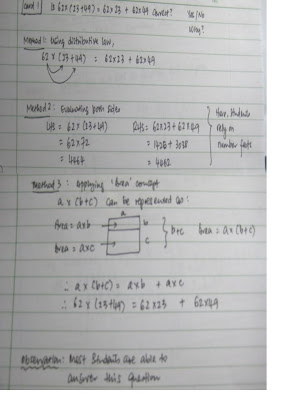


by Dr Ida Mok Ah Chee 莫亚慈
~~~~~~~~~~~~~~~~~~~~~~~
From the beginning, Dr Mok already 'tuned' our expectation - she emphasized that what's she going to share is on a study where she used an instrument to diagnose the 'cause', and not to propose any solution to the problem identifed. The purpose is to surface symptoms so as to help one to draw out more information about a problem. She also shared that, from the researcher's point of view, we learn from when the 'subjects' made more mistakes - there's where we could find out how one thinks.
Was wondering - what's distributive rule - to me, it's just a procedure that we perform, when need to 'open' brackets - ie. doing expansion. It's amazing, especially when we go beyond 2 terms within each factor. Things can get so complicated and become out of hands!
In fact, it goes all the way back to our understanding of the 'letters' used in mathematics - its meaning changes when put in different context. Here are some commonly made mistakes when dealing with distributive law.
Example 1: (t+1)²
=t² + 1²
= (t² + 1)
Example 2: 5 (x²)(2xy)
=(5 x x² )(5 x 2xy)
= (5 x² )(10 xy)
Example 3: cos 90° - cos 30°
= cos(90° - 30° )
= cos 60°
At one point, it's mentioned that Distributive property is a systemic rule that links multiplication and addition - and in fact, division "is" multiplication while addition "is" subtraction. Well, sounds abstract??? Not really, it brings us back to the fundamentals...
- 5 - 2 = 5 + (-2)
- 5 ÷ 4 = 5 x ¼
Thursday, February 28, 2008
Reflection: Workshop for HOD/Maths (2nd run)
@ Chung Cheng High (Yishun), 21 & 28 February 2008
~~~~~~~~~~~~~~~~~~~~~~~~~~~~~~~~~~~~~~~
This is the 2nd run of the workshop - saw some improvements over the 1st run, but there were also areas not carried out so smoothly, as compared to previous run.
What I thought we did well:
~~~~~~~~~~~~~~~~~~~~~~~~~~~~~~~~~~~~~~~
This is the 2nd run of the workshop - saw some improvements over the 1st run, but there were also areas not carried out so smoothly, as compared to previous run.
What I thought we did well:
- Bold enough to try a new grouping strategy. Thought it was refreshing - not just participants' feedback, but I felt so... a change :D Still remember I said that, "Let's do it in an non-ICT way!" I guess that surprised some participants!
- Beefing up the resources for the "ICT tools in Education" component. Thought it was a right move, introducing them a wide range, and really getting every group to crack their head. However, because of the lack of time, there are several repetitive ones... so, it would be perfect if have taken care not to feature similar ones.
- Of course, it's encouraging, to hear from Ivy that at least one of the resources have been used by her teachers already! :D
- Good that tea break was ready right at the start of the workshop... Ahha... participants were pampered! Well, we managed to steal some time lah...
Things that did not go that well:
- Time management - one of the worst rounds - all I could blame, because I forgot to wear my watch for the 1st session. Was so lost... No good... There wasn't any wall clock in the lab, too... Lesson learn: No matter what, depend on thyself!
- Lab arrangement - not very conducive for a large group, especially the cluster right in front of the teachers' station... Can't see at all! What kind of awkward design!!!
- More can be done when participants shared about the learning gaps!
- Should not have told them the "Deliverables" of the learning activity - I'm referring to the Integration matrix. By now should have learnt what are the buttons not to trigger!!! Please remember - never never mention the word "deliverable"!
Saturday, February 23, 2008
Talk: HINDUISM REDISCOVERED - A Religion in Vogue
by Vivekacharya Pavan Choudary (on February 22, 2008; 7:00pm to 8:30pm @ SMU)
Chanced upon the publicity advertisement on last Sunday's newspaper. Hey, looked interesting, I thought... Hinduism? It has always been a mysterious yet colourful religion in my eyes. It's also a rather complicated one, I thought, equivalent to Taoism - with lots of gods and deity stories. This is very unlike religions like Buddhism, Christianity and Islam where there's one significant figure that people can associate with. Hey, what a chance! So, I signed up - really, curiosity drives action :D
No doubt, after the 1½ hours, learnt more about the religion. The talk was interesting though yawned a couple of times because of the early bird symptom... hahaha... Pavan delivered the talk with strength and belief... with humour, and it's so easy to understand - of course, because it's not in depth (else could be very donning...) And yes, the entertainment by his assistant, who sang several verses of the poems by Kabir.
Hinduism - the belief touches on
- transmigration of the soul - which implies the soul does not die after death, it casts itself into another body.
- karma - doctrine of compensation - this is equivalent to what you reap is what you soar, though it could carry across several lives.
- hierarchy - yes, this is certainly reflective at the caste system.
In a nutshell, here's some points jotted down in that evening...

Another "Thought of the Day"... When someone throws stones at you, use it to build the castle
Reflection: Workshop on Spreadsheet (Secondary) 1st Run
@ First Toa Payoh Secondary School, 13 & 20 February 2008 (Link to Workshop Blog)
~~~~~~~~~~~~~~~~~~~~~~~~~~~~~~~~~~~~~~~~~~~~~
险象环生
In the original plan, we did not even thought of facilitating the spreadsheet workshop via a blog... thought of adopting the same approach - using a Shared Spreadsheet to manage the group work and responses from participants. Nevertheless, despite of the pre-workshop preparation, the network played us out! (more seriously than our encounter at Teck Ghee Primary last year). Sigh!
Fortunately, created the blog just 15 minutes before the (1st) session began. Well, luck seemed not at our side that day! To our shock! only the teacher's PC and a couple of other stations work! Oops! Really 人算不如天算!This was all because the network was switched-off because there was CPA coursework in the morning.
Luckily (in fact we had never get ourselves so well-prepared for continguency!) we still have post-its! hahaha... 天无绝人之路. Phew! Hm... now: Whenever we go for workshop, we shall bring along with us the emergency pack!
Because of the technical problems, the overall impression was really Chaos! Halfway through the presentation (at the beginning), all the participants' systems 'froze' ('cos WK solve the network issue - one learning point: Never never meddle (or explore!) with anything that we are not familiar with... This prevents unnecessary disruption)
迟到大王
Another observation:
Hey, many (well, must emphasize the point that it's not all) Maths teachers tend to be late! Hey! where's this value of observing punctuality? In fact, we had a group of teachers (more than 5) from a school who were late for almost 20 min. Yet, did not take to heart that they disrupt the flow/on-going of the workshop. Oh yes, another point I don't quite understand - not all teachers from the hosting school were punctual! Indeed, we had teachers from the far north arrived ontime!
~~~~~~~~~~~~~~~~~
Something we did (for the first time)... before the 2nd session...
~~~~~~~~~~~~~~~~~~~~~~~~~~~~~~~~~~~~~~~~~~~~~
险象环生
In the original plan, we did not even thought of facilitating the spreadsheet workshop via a blog... thought of adopting the same approach - using a Shared Spreadsheet to manage the group work and responses from participants. Nevertheless, despite of the pre-workshop preparation, the network played us out! (more seriously than our encounter at Teck Ghee Primary last year). Sigh!
Fortunately, created the blog just 15 minutes before the (1st) session began. Well, luck seemed not at our side that day! To our shock! only the teacher's PC and a couple of other stations work! Oops! Really 人算不如天算!This was all because the network was switched-off because there was CPA coursework in the morning.
Luckily (in fact we had never get ourselves so well-prepared for continguency!) we still have post-its! hahaha... 天无绝人之路. Phew! Hm... now: Whenever we go for workshop, we shall bring along with us the emergency pack!
Because of the technical problems, the overall impression was really Chaos! Halfway through the presentation (at the beginning), all the participants' systems 'froze' ('cos WK solve the network issue - one learning point: Never never meddle (or explore!) with anything that we are not familiar with... This prevents unnecessary disruption)
迟到大王
Another observation:
Hey, many (well, must emphasize the point that it's not all) Maths teachers tend to be late! Hey! where's this value of observing punctuality? In fact, we had a group of teachers (more than 5) from a school who were late for almost 20 min. Yet, did not take to heart that they disrupt the flow/on-going of the workshop. Oh yes, another point I don't quite understand - not all teachers from the hosting school were punctual! Indeed, we had teachers from the far north arrived ontime!
~~~~~~~~~~~~~~~~~
Something we did (for the first time)... before the 2nd session...
- To address the latecomers issue... it's the first time we sent an email to all participants that we would be starting the 2nd session punctually because of 'additional skill building' built into the workshop. {So, this is the 'plan'}
- On the day, we kept to our words to execute the plan. at 2.35 pm, we started... despite only about 5 were here... Think the participants were a bit surprise... but we carried on. Of course, those who came in this time came in quietly... hahaha... seems working :P
Thursday, February 21, 2008
Experimenting with slide show
Hurray! I've succeeded!
It's much easier than I've expected... In fact had given up the 'hope' of uploading external files into the blogger - it seemed so difficult unless there's a button at the Compose mode.
Anyway, this curiosity came again after the recent Weblog workshop when participants asked about it again... and (don't know what made me do this... but) I asked Paul how to do it in blogger. Immediately, he could rattle off a couple of ways... there it goes, how could the "blog queen" not knowing how to do? hahahaha...
Sunday, February 17, 2008
Reflection: Workshop on Weblog for Maths (Secondary)
This is a revised version - compared to last year. 2 distinctive differences:
- separate the primary and secondary participants - so this run is solely for participants from secondary schools
- reduce the number of sessions from 3 to 2.
A few areas we could have done better:
- The different uses of blogs in Maths learning - could not quite elicit what we wanted from the participants (unlike last year). I think, it's the illustration that made a difference in the quality of outputs and I think, also the alignment of views between the trainers.
- Implementation of activities - only slightly more than 50% managed to put up something in their blog (for the class); even a smaller number manage to get pupils to participate. However, from those who managed to get pupils to participate, we could surface certain 'concerns' for discussion. We also saw a couple of participants whose practice differ from the rest, hence enable us to share the 'authentic' cases with the class.
- Response to the participants after 1st session was not quickly put up... which I hope to do that earlier...
- Oops! Forget to cover activity 6 (though it's a small activity)
Something that I thought that's done pretty well:
- We managed to complete most of what's planned (except Activity 6 in the 1st session)
- In session 1, manage to build in the 'understanding of dashboards and blogs' quite naturally
- In session 2, it's the first time that we attempt to get participants to help recap what's done in the 1st session through an activity - go round robin to jot down what each could recall one thing they did in Session 1 workshop... then go around the groups, each taking a turn to say out one of the responses they gathered within the group... until it's exhausted... hm... hype up the class a little - they are more relax... for a moment, thought I'm in a game show
- As we continue... another activity where the participants were to surface what are the "can" and "cannot" do in group blogs - it's the first time to divide the class into 2 big groups, and within each big group to think of answers to the assigned question.
- Somehow, find that the participants have been pretty forthcoming in participating in the activities.
Something new that hope to "pick up" from this workshop...
- We are also quite bold in inviting participants to register to participate in the social network. Though almost all signed up however, due to the authentication process, they could not get into the group immediately... anyway, I thought it was a good try.
Subscribe to:
Posts (Atom)